


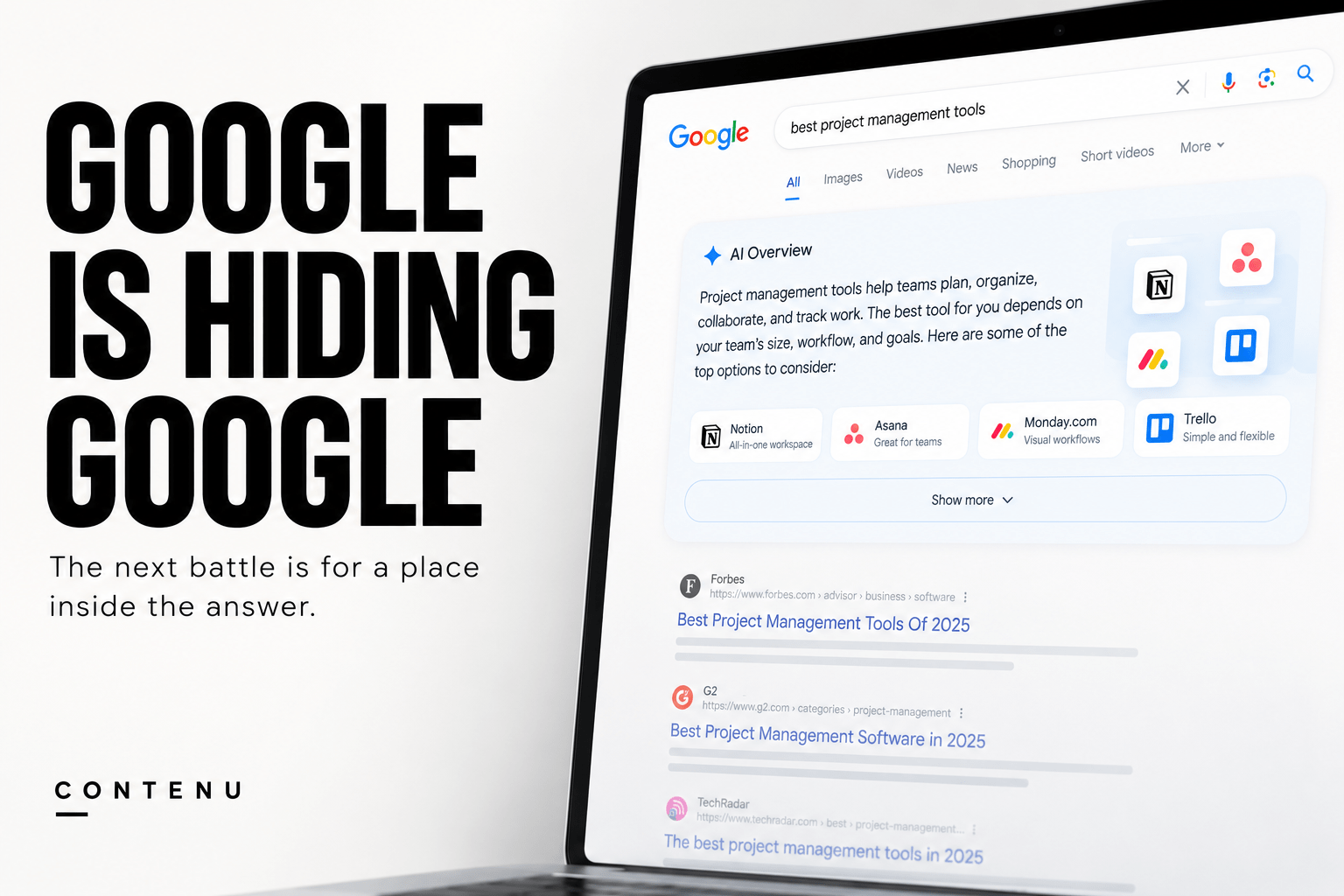
Google is increasingly placing AI-generated answers before traditional organic results in some search experiences. Traditional rankings still matter, but ranking well no longer guarantees that a business appears inside the AI-generated answer a customer sees first. Businesses now need to evaluate both their traditional SEO visibility and their AI Search visibility as separate, connected concerns.
Google is still Google. But the part of Google most users see first is changing.
In some searches, an AI-generated answer now appears before the traditional list of results. Users can follow up, ask related questions, and continue the conversation, much the way they do with ChatGPT or Claude. The traditional organic listings are still there. They are just further down the journey.
For businesses that have spent years building strong rankings, that shift deserves serious attention.
It is a provocation, not a eulogy.
Traditional search results have not disappeared. But when Google presents an AI-generated answer at the top of a search experience, the familiar list of blue links gets pushed lower. Some users get what they need from the generated answer and never scroll further. That is a meaningful change in how discovery actually works.
So the phrase captures something real. Google, the AI-powered experience, is beginning to sit in front of Google, the index of ranked pages. Whether a user reaches those organic results now depends partly on what happens in the AI layer first.
For a long time, the search experience looked roughly like this: user types a query, Google returns a ranked list of pages, user clicks the most relevant one.
That model is not gone. But in Google AI Mode, an AI-powered search experience that can generate synthesized answers and support conversational follow-up questions, some searches now work differently. The user asks a question, receives a generated response, and is invited to keep the conversation going. It feels closer to how people use conversational AI tools than to traditional keyword search.
What changes for businesses is the order of discovery. In those experiences, the AI-generated answer comes first. The ranked page may come later, if at all.
They remain present. That matters, and it is worth saying plainly before going further.
Years of SEO work do not simply become irrelevant because AI-generated answers exist. Strong organic rankings still drive traffic. They still signal authority. They still represent real customer acquisition.
But their position in the customer’s discovery journey may shift. When a generated answer appears first and satisfies the user’s question, traditional results may receive less direct attention on that query. Not always. Not universally. In some searches, for some users, in some experiences.
That qualification matters. This is not a sudden collapse. It is a gradual change in how attention is distributed across a search experience.
Yes. Ranking well still matters.
But here is the problem with letting that answer stop there. Ranking and visibility are not the same thing anymore, and treating them as identical is where businesses can quietly fall behind.
Ranking describes where a page sits in Google’s organic index. Visibility describes whether a customer actually encounters the business during their search experience. Those two things have always been related. Now there is a third layer between them: the AI-generated answer a customer may read before they ever reach the ranked results.
A business can hold position one in organic search and still be entirely absent from the AI-generated answer a customer reads first. Those are not contradictory outcomes. They measure different things.
Yes. SEO still matters. Strong organic rankings continue to drive traffic and signal credibility. But ranking alone may no longer represent the complete picture of search visibility. In search experiences where AI-generated answers appear first, businesses also need to understand whether they are present inside those answers, not just below them.
This is the question that most businesses have not started asking yet.
It can. A well-optimized page that ranks consistently in traditional search may receive no mention in the AI-generated answer a user reads before scrolling down. That is not because the page is low quality. It is because traditional ranking signals and AI-generated answer retrieval are not the same mechanism measuring the same thing.
AI Search, meaning search and discovery experiences in which AI systems generate or synthesize answers rather than only presenting a ranked list of links, draws on a different set of signals when constructing a response. Whether a business or source gets included, referenced, or surfaced in that answer depends on how clearly its expertise is represented, how credibly it appears across multiple sources, and whether the AI system has enough reliable information to treat it as a relevant authority on the topic being queried.
A technically sound, well-ranked website does not automatically satisfy those conditions.
Yes. A strong organic ranking and visibility inside an AI-generated answer are not the same outcome. A business can hold position one in traditional search while being absent from the AI-generated answer that appears above those results in some search experiences. They measure different signals.
Traditional SEO focuses on helping content and websites become discoverable inside search engines. It works primarily through signals that influence how a page ranks in an index: relevance, authority, structure, technical quality, inbound links.
Generative Engine Optimization, or GEO, is a distinct and newer discipline. It focuses on improving how clearly and credibly a brand, entity, or source can be understood and potentially retrieved or referenced inside AI-generated search experiences. It asks different questions. Not only: does this page rank? But also: does the AI system understand what this company does, recognize its expertise, and have sufficient reliable information to surface it when a relevant question is asked?
These are not competing disciplines. They increasingly interact. Strong SEO can support AI visibility. But SEO alone does not automatically produce it.
Generative Engine Optimization, or GEO, focuses on improving how clearly a brand, expertise, or source can be understood and potentially referenced by AI systems that generate search answers. It is distinct from traditional SEO, which optimizes for organic rankings in a search index, but the two disciplines increasingly work together.
This is where honest answers require a measure of caution.
Google has not published a definitive technical explanation of how AI-generated answers select which sources to include or reference. Anyone claiming otherwise is inventing specificity the public record does not support.
What the description of this shift does raise, and what businesses can usefully evaluate, is a set of related questions:
None of these questions guarantee inclusion in an AI-generated answer. But they describe the territory businesses should be examining. Visibility that depends entirely on a single ranking signal is narrower than it used to be.
AI Search visibility refers to whether a business, brand, or source appears inside an AI-generated answer when a relevant query is made in an AI-powered search experience. It is separate from organic ranking and requires a different evaluation. A business can have strong organic visibility and low AI Search visibility at the same time.
For years, the central marketing question around search was: where do we rank?
That question still matters. It just no longer captures the full picture.
Throughout the history of digital search, each major shift in how people find information has reshuffled which businesses got seen first. The businesses that recognized those shifts early adapted their visibility strategies ahead of the change. The ones that waited responded to a new reality rather than shaping it.
AI Mode in Google is one of those moments. Not a sudden discontinuity. A gradual expansion of the search experience into territory that traditional rankings were never designed to occupy.
As the provided description puts it directly: the next battle is not simply for the top of the search results. It is for a place inside the answer.
That is a different kind of visibility. And it requires a different kind of thinking about how a brand is represented online.
No. Google AI Mode is an expansion of the search experience, not a replacement for traditional search results. Organic rankings still exist and still drive traffic. What has changed is that in some searches, an AI-generated answer now occupies user attention before those traditional results appear. Both matter. They measure and serve different moments in the customer journey.
It is worth addressing this directly, because the conversation around AI Search has generated a fair amount of premature certainty in both directions.
SEO is not obsolete. The definition of search visibility is getting bigger.
A business that abandons SEO investment because AI Search exists is making the same mistake as a business that ignores AI Search because it already ranks well. Both positions are too narrow for the current environment.
The more accurate frame is this: traditional SEO and GEO increasingly need to work together. Strong organic content can support how AI systems understand a brand’s expertise. Clear entity representation can reinforce both ranking signals and AI retrievability. A well-structured website remains a foundational asset whether the customer arrives through a ranked link or after reading an AI-generated answer that cited it.
The disciplines interact. Neither replaces the other.
No. SEO remains a foundational channel for search visibility and customer acquisition. The argument is not that SEO is obsolete. The argument is that ranking well may no longer represent the complete picture of whether a business is visible in search. Businesses should continue SEO investment and add AI Search visibility to what they evaluate and manage.
A practical starting point for any business trying to understand where it stands:
These are diagnostic questions, not conclusions. The answers will differ for every business, every category, and every market. But they describe the right territory to examine.
At CONTENU, the shift toward AI-generated search has changed how we approach brand visibility for our clients.
The principles we apply reflect the current environment:
If a business has invested seriously in SEO but does not yet know how it appears inside AI-generated answers, that gap is worth closing. Comparing traditional search visibility with AI Search visibility and identifying where the two diverge is a practical next step. Our team at CONTENU works through that analysis as part of how we approach search strategy for the businesses we partner with.
Not a wholesale strategy overhaul. A clear-eyed look at current visibility across both dimensions.
Businesses should measure AI Search visibility separately from organic rankings. That means actively checking whether the company appears in AI-generated answers for relevant queries, how it is described when it does appear, and which sources are shaping that description. Traditional rankings and AI visibility are connected but not equivalent metrics.
Yes, SEO still matters. Strong organic rankings continue to drive traffic, signal authority, and represent real customer acquisition value. What has changed is that ranking well no longer tells the complete story of search visibility. In some search experiences, an AI-generated answer appears before traditional results. Businesses now need to understand their visibility in both layers, not just one.
Yes, and this is one of the more important distinctions businesses need to understand right now. A strong organic ranking and inclusion in an AI-generated answer are not the same outcome. They draw on different signals and serve different moments in the search experience. A well-ranked page does not automatically qualify as a source an AI system will surface or reference when generating an answer.
Traditional SEO focuses on helping pages and websites rank in search engine indexes through relevance, authority, and technical quality signals. Generative Engine Optimization, or GEO, focuses on improving how clearly a brand, expertise, or source can be understood and potentially referenced inside AI-generated search experiences. SEO works primarily on ranked position. GEO works on entity clarity, source credibility, and AI retrievability. They are different disciplines that increasingly need to work together.
A practical starting point is to ask the questions your customers are likely asking, directly inside AI-powered search experiences like Google AI Mode, ChatGPT, Gemini, or Perplexity. Observe whether your business appears, how it is described, and which sources are referenced. Then compare those results to your traditional organic rankings for the same queries. Where the two diverge, you have found the gap worth addressing.
At a Glance