


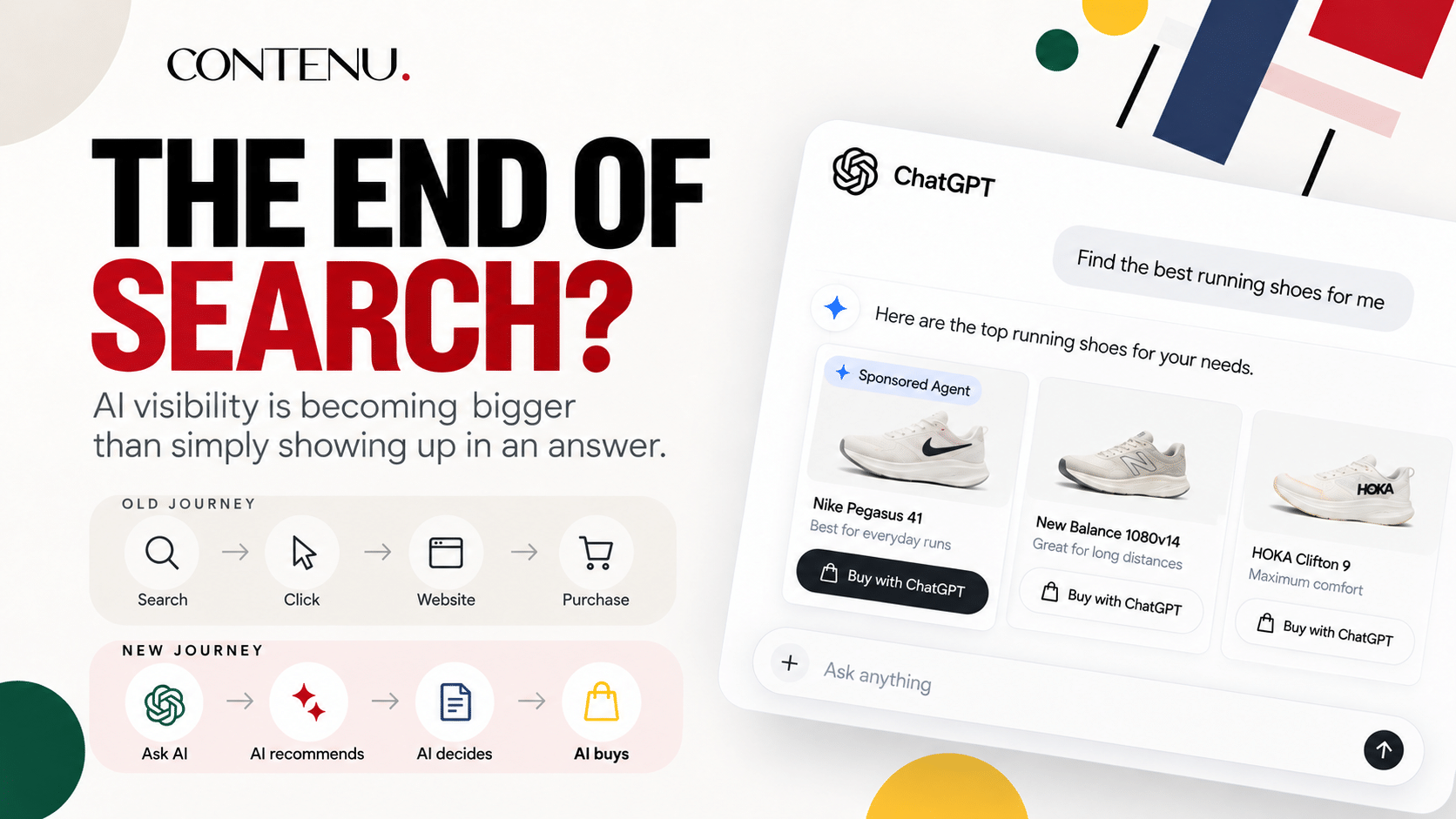
AI systems are beginning to play a larger role between discovery and action. Sponsored Agents inside ChatGPT may allow users to interact conversationally with a business before ever visiting its website. As AI agents increasingly help compare and evaluate options, brands may need to think beyond simply appearing in an AI-generated answer. Being understood, compared, and represented correctly inside these systems is becoming part of what AI visibility means.
For years, digital marketing ran on a reliable sequence. A customer searches, clicks, lands on a website, compares a few options, and decides. The whole model assumed the customer was doing the moving, one step at a time, and a brand’s job was to be present and persuasive at each stop along the way.
That sequence is under pressure. This week, OpenAI introduced Sponsored Agents inside ChatGPT. At the same time, AI agents are beginning to shop, compare, and in some cases help complete purchases on behalf of users. Neither development alone rewrites marketing. Together, they suggest the customer journey is changing in ways worth paying attention to now.
The traditional digital ad worked in one direction. A business paid for placement, a customer saw it, clicked, and arrived at the company website. The business and the customer met there.
Sponsored Agents change that sequence. Instead of clicking an ad and navigating to a separate page, a user can start a conversation with an AI agent connected to a business, inside ChatGPT itself. In plain terms: a Sponsored Agent is a business-connected AI system a user can interact with conversationally, without leaving the platform. The interaction happens before the website visit, and in some cases instead of it, at least initially.
What that means for targeting, pricing, or technical implementation is not something the current announcement confirms in full detail. What it does confirm is the direction: AI is moving closer to the point of discovery and interaction, not just information retrieval.
At first, Sponsored Agents look like another ad format with a conversational wrapper. That framing undersells the shift.
If a customer can interact with an AI agent representing a business, that agent may answer questions, explain services, and help the customer evaluate options, all before the company website enters the picture. The first real impression of the business may form through an AI conversation rather than a homepage. That changes what discovery means, and it changes what brands need to be ready for.
That does not mean brands need to rebuild their entire strategy immediately. But it does mean they should start paying attention to where AI is entering the customer journey, because the entry point is moving earlier.
The traditional digital journey looked like this:
Search. Click. Website. Purchase.
Each step was something the customer did personally. They opened the search bar, chose a result, navigated the website, compared options, and transacted. The business’s job was to show up clearly at each step.
The emerging possibility looks different:
Ask AI. AI recommends. AI helps compare. AI helps decide. AI may facilitate the next action.
Not every customer journey follows this path today. Not every product or service category supports it. But the direction is real. AI systems are increasingly capable of consolidating steps that customers used to perform manually, and when that happens, a brand may be evaluated before the customer ever reaches its website.
For brands, the consequence is practical. Fewer visible steps in the journey means fewer opportunities to show up between the question and the decision. Being understood by AI systems early in that process carries more weight than it used to.
Probably not the end of search itself. The more important change is that searching may become less visible as a distinct activity, because AI systems can combine discovery, comparison, and follow-up inside one conversation. The customer asks a question. The AI handles retrieval, synthesis, and comparison. The journey compresses.
So the shift is less about search disappearing and more about its individual steps becoming less obvious. A customer using an AI assistant may not experience “I searched, then I clicked, then I compared” as three separate moments. It may just feel like one conversation that led somewhere useful.
For brands, that compression raises a reasonable question: if fewer steps are visible, are there fewer places to show up? Possibly. Which is part of why being understood correctly at the start of that conversation matters.
Agentic commerce refers to shopping or commercial experiences where AI agents help perform parts of the discovery, comparison, decision, or transaction process on behalf of a user. The level of AI involvement varies. In some experiences, an agent may surface options and stop there. In others, it may compare products, draft a recommendation, or help move toward a purchase.
This is not a universal capability today, and it does not mean AI agents are autonomously making purchases for every user across every product category. It is an emerging model, and the degree of involvement depends heavily on the platform and what it currently supports.
Traditionally, researching a purchase meant opening several tabs, reading reviews, comparing features, visiting a couple of websites, and eventually deciding. The customer was the one moving through each step.
An AI agent may increasingly consolidate some of those activities, retrieving information from multiple sources, comparing relevant options, and surfacing a recommendation, without the customer doing each step manually. That creates a different set of questions for businesses:
These are not entirely new questions. But AI-mediated commerce gives them more urgency. If an AI system has difficulty interpreting a brand’s offer, that can create problems when the system is asked to compare or represent it. The brand may be surfaced inaccurately, or not surfaced at all in that context.
Most early discussion around AI Search focused on one question: does this brand appear in the answer? That still matters. But it is no longer the whole picture.
As AI systems move closer to commercial decisions, the relevant question expands. It helps to think about increasing levels of AI involvement:
AI understands the brand. AI retrieves it when relevant. AI mentions or cites it in a generated answer. AI compares it with alternatives when a user is evaluating options. AI may recommend or help select an option. AI may help facilitate an action or transaction.
These are not guaranteed outcomes, and they are not stages every brand will move through on a predictable schedule. They are a way of understanding how the question of visibility is changing. A brand that is only thinking about the citation stage may not be prepared for what comes after it.
This is also not a uniform process across every AI platform. Different systems have different capabilities, and that will continue to shift as the technology develops.
Generative Engine Optimization focuses on how clearly and credibly a brand can be understood, retrieved, and referenced in AI-generated discovery experiences. Early conversations about GEO tended to center on visibility and citations. That is still a reasonable starting point.
But as AI moves closer to commercial decisions, the information it needs from a brand expands. Not just “what does this company do,” but: what exactly do they sell, who is it for, how does it compare to relevant alternatives, and what evidence of quality or credibility exists? These are not confirmed AI ranking factors. They are the types of information AI systems may need in order to represent a business accurately when a customer is evaluating options.
Brands that make this information clear and consistent across owned and external sources are better positioned to be understood correctly. Whether that translates to being recommended depends on many other factors, including the platform, the query, and the competitive context.
These three concepts describe different layers of the same underlying goal: being present and credible when a customer is deciding.
SEO helps businesses become discoverable through search engines. Pages rank, links matter, structured content gets indexed. It is still relevant.
GEO focuses on how clearly and credibly a brand can be understood and referenced in AI-generated experiences. Where SEO asks whether search engines can find something, GEO asks whether AI systems can correctly interpret and surface it.
Agentic commerce describes commercial experiences where AI agents may help with parts of discovery, evaluation, recommendation, or transaction. It is not a replacement for the first two. It is a further development of what they are ultimately trying to serve.
SEO and GEO can support different layers of discoverability, and both may become relevant as AI-mediated commerce develops. The overlap is real. A brand with a well-structured, credible web presence tends to be in a better position across all three.
The emergence of AI agents does not make websites irrelevant. A website is still an authoritative source of structured information, a conversion environment, and an owned asset the brand controls entirely. It is still where deeper research, trust-building, and transactions happen.
In short: a website still matters. The shift is that a customer may now encounter and partially evaluate a brand before arriving there. The first impression may form in an AI conversation rather than on the homepage. That means the website may need to earn the visit more deliberately than it once did, but it does not stop being important.
Before assuming current rankings and traffic tell the full story, these questions are worth working through:
None of these require expensive tools to start answering. They do require looking at the business through a different lens than the one most brands have used for the last decade.
Clear service or product descriptions, explicit differentiators, defined audiences, and accurate category information all help AI systems interpret a brand correctly. If a business relies on implication or industry shorthand to communicate what it does, that may not translate well when AI is trying to compare it against alternatives. The more explicit the better, not just for search engines, but for any system trying to surface the right option for the right question.
The website, service and product pages, and core content are still the most controllable sources of brand information. Keeping that information accurate, complete, and structured matters more as AI systems draw from it to answer commercial questions. Owned content is still a foundation, even if the customer no longer always starts there.
Relevant reviews, reputable mentions, expert content, and consistent public information may help shape how a brand is understood across the sources AI draws from. This is not a confirmed ranking mechanism. It is simply how reputation and credibility tend to work: AI systems, like people, are more likely to treat a brand as relevant when multiple credible sources point in the same direction.
An AI mention is not a lead. An AI recommendation is not a sale. As the customer journey becomes more AI-mediated, measurement needs to stay grounded: visibility and engagement on one side, qualified inquiries and actual revenue on the other. Collapsing those categories makes it harder to know whether any of this is working. The visibility metrics are worth tracking. They are just not the same as business results.
The honest starting point is that AI visibility is moving beyond simple answer inclusion, and brands that are only tracking citations are looking at part of the picture.
Traditional SEO still matters. Websites still matter. The foundations have not dissolved. But GEO is increasingly about whether AI systems can understand a brand with enough clarity and credibility to surface it correctly when a customer is in the middle of deciding. That is a harder, more interesting question than “do we appear in the answer.”
As agentic commerce develops, the question becomes more commercial still. Not just “does AI know this brand exists,” but whether AI can represent it accurately when a customer is comparing options. And whether that visibility eventually leads anywhere measurable.
At CONTENU, that last part matters as much as the first. Visibility is a signal. What happens downstream is the actual story.
Most businesses have a reasonable picture of where they rank in Google. Far fewer know how AI systems currently describe, compare, or represent them when a customer asks a relevant question.
That gap is worth closing. The useful first step is to compare what your business says about itself with how AI systems currently surface and describe it. Those two things are often not as aligned as they should be, and the difference matters more as AI takes on a larger role in the customer journey.
Sponsored Agents are a feature introduced by OpenAI that allows users to interact conversationally with an AI agent connected to a business, inside ChatGPT. Instead of clicking a traditional ad and navigating to a website, a user can engage with a business through a conversation within the platform. The full scope of the feature, including targeting, pricing, and eligibility, goes beyond what the current announcement confirms in detail.
Agentic commerce describes commercial experiences where AI agents help perform parts of the discovery, comparison, decision, or transaction process on behalf of a user. The degree of AI involvement can range from surfacing options to helping complete a purchase, depending on the platform and its current capabilities. It is an emerging model, not a universal standard across every product category today.
Not replace, but the shape of the journey may change. AI systems can combine discovery, comparison, and recommendation inside one conversation, which may compress steps customers previously handled separately. Websites remain important as authoritative sources and conversion environments. The shift is that customers may form early impressions through AI before they arrive, which changes how brands need to think about their first point of contact.
Start by making the business clearly understandable: consistent information, explicit differentiators, credible external presence, and well-structured owned content. Then check how AI systems currently describe and compare the business, not just how it ranks in traditional search. And keep measurement grounded: AI visibility and business outcomes are not the same thing, and treating them as equivalent leads to decisions made on the wrong data.
At a Glance